

How to Read the Bible in Context and Avoid Common Interpretation Mistakes
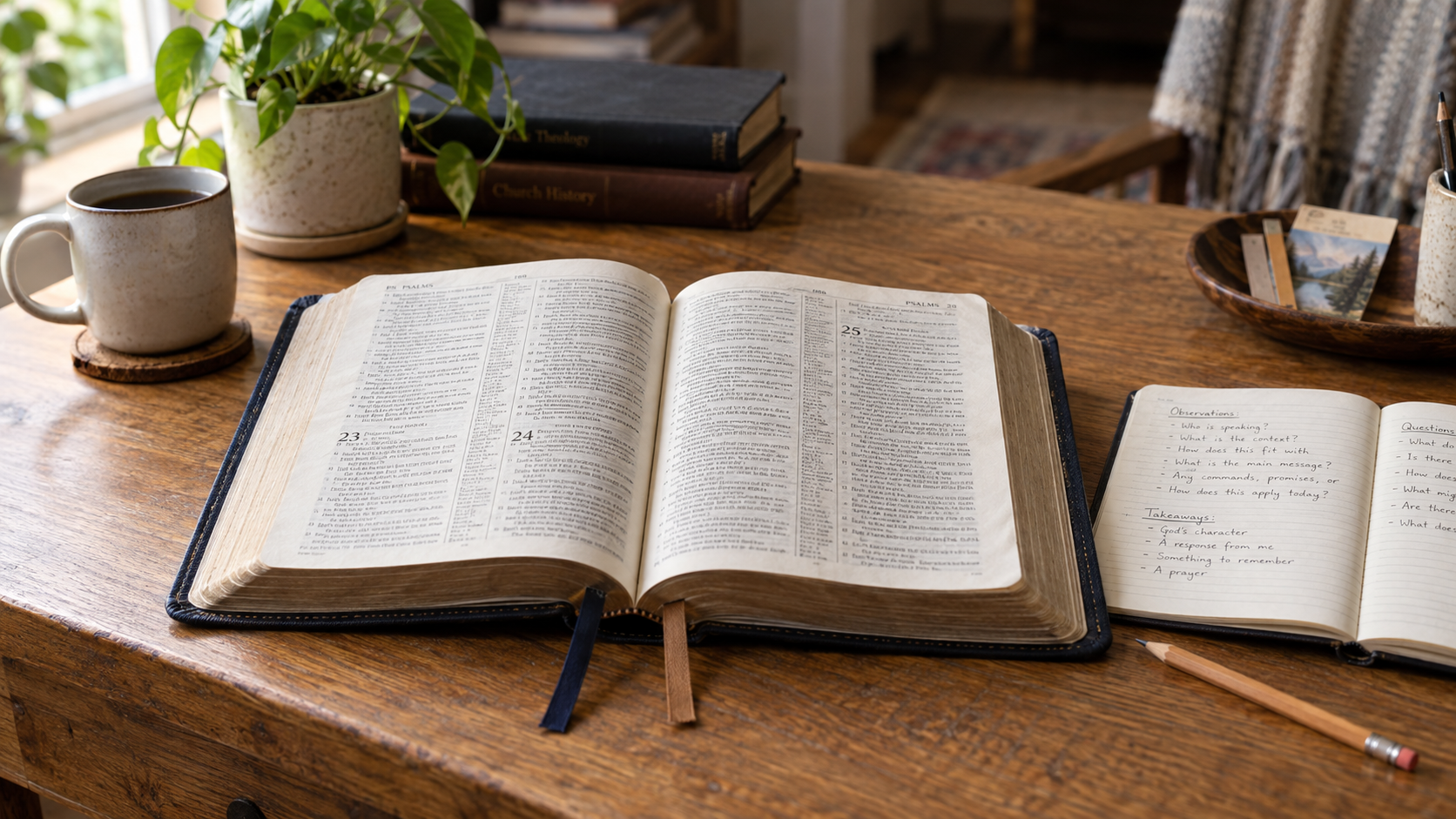
Have you ever read a Bible verse, felt certain you understood it, and then discovered that the surrounding passage changed your perspective?
A verse on a coffee mug or social media graphic may offer encouragement. But understanding what Scripture teaches requires paying attention to where those words belong.
Learning how to read the Bible in context helps you understand the message of a passage, avoid common interpretation mistakes, and apply God’s Word faithfully.
You do not need a seminary degree to begin. You need a willingness to slow down, ask good questions, and let Scripture shape your understanding.
What Does It Mean to Read the Bible in Context?
Reading the Bible in context means understanding a passage in light of its surrounding verses, original audience, literary form, and place in the larger biblical story.
Consider a text message that says, “That was unbelievable.” Depending on the conversation, it could express delight, frustration, or disbelief. The surrounding words help you understand the intended meaning.
Context serves a similar purpose when reading Scripture.
Four kinds of context deserve attention:
Literary context: What comes before and after the passage? How does it fit the book’s argument or story?
Historical context: Who is speaking or writing, who is receiving the message, and what circumstances are being addressed?
Genre: Is this narrative, poetry, wisdom, prophecy, a letter, or another kind of writing?
Biblical context: How does the passage fit within Scripture’s unfolding account of creation, sin, redemption, and restoration?
These questions help you move from an isolated sentence to a fuller understanding of God’s Word.
1. Begin with Prayer and a Willingness to Learn
Before studying, ask God to give you understanding and a heart ready to respond.
A simple prayer might be:
Lord, help me understand what this passage teaches. Show me where my assumptions need to change, and help me obey what I learn.
Prayer and careful reading belong together. Dependence on God should make us attentive, humble readers.
Come prepared to encounter something that challenges you. We all bring experiences, preferences, and assumptions to the Bible. Recognizing them helps us listen more carefully.
2. Read the Whole Passage Before Focusing on One Verse
One of the most useful Bible study habits is also one of the simplest: read more than the verse that caught your attention.
Read the complete paragraph or section. If the meaning remains unclear, read the chapter and review the book’s broader message.
Look for connecting words:
Therefore points back to an earlier explanation.
Because introduces a reason.
But signals a contrast.
So that often explains a purpose.
These words show how ideas fit together.
Example: Philippians 4:13
Philippians 4:13 is sometimes treated as a promise that believers can accomplish any personal ambition.
In the surrounding verses, however, Paul describes learning contentment in both abundance and need. His confidence concerns Christ’s strength as he faces changing circumstances, including hardship. Read Philippians 4:10–13, ESV.
A faithful application is to depend on Christ when life is difficult and cultivate contentment when circumstances change. The passage does not guarantee that every goal will succeed.
Try this: Before applying a favorite verse, summarize the surrounding paragraph in one sentence.
3. Identify the Original Audience and Situation
The Bible speaks to readers today through writings first addressed to people in particular circumstances.
Ask:
Who is speaking, and to whom?
What problem, question, or situation is being addressed?
Is this a command, promise, warning, prayer, or description?
Does the text identify conditions or a particular group of recipients?
Often, the passage itself supplies important answers. A book introduction or study Bible can help with background that is less obvious.
Example: Jeremiah 29:11
Jeremiah 29:11 appears in a letter to Jewish exiles in Babylon. The surrounding passage tells them to build homes, plant gardens, and seek the welfare of the city. It also places the promised return beyond an extended period of exile. Read Jeremiah 29:1–14, ESV.
That setting matters. The verse does not promise every reader immediate success or a life without suffering.
Christians can draw encouragement from God’s faithfulness while recognizing that this particular promise addressed an exiled community. Its context encourages patient trust rather than certainty about our preferred timetable.
4. Pay Attention to the Kind of Writing
Faithful interpretation takes literary form seriously. We already do this when we read a poem differently from an instruction manual.
The same care belongs in Bible study.
Narrative
Biblical narratives tell us what happened. Some actions provide examples to follow; others reveal sin, failure, or its consequences.
The fact that a biblical character did something does not automatically make it a command for us.
Poetry
Psalms and other poetic passages use imagery, repetition, and metaphor. References to God as a rock communicate truths about his strength and dependability through figurative language.
Wisdom
Proverbs often describe patterns of wise living and their usual results. Read them as wisdom sayings within the wider teaching of Scripture, with attention to each saying’s wording.
Treating every proverb as an unconditional guarantee can lead to misplaced expectations.
Letters
New Testament letters develop arguments and address real congregations or individuals. Follow the writer’s train of thought instead of treating every sentence as a separate topic.
Prophecy and Apocalyptic Writing
These passages may combine warnings, promises, symbolic imagery, and visions. Begin with their historical setting and biblical connections before relating them to contemporary events.
Try this: Name the genre before deciding how to interpret a passage.
5. Understand the Passage Before Applying It
A helpful Bible study method uses three steps:
Observation: What does the passage say?
Interpretation: What does it mean in context?
Application: How should I respond?
Keeping these questions distinct helps prevent personal feelings from becoming the deciding factor in interpretation.
For observation, identify repeated words, commands, contrasts, and key people.
For interpretation, explain the passage’s main point using the surrounding text.
For application, choose a response that follows from that meaning.
A passage may have several faithful applications. A teaching about generosity, for example, might prompt one person to share food and another to offer financial help. Both responses should remain connected to what the text actually teaches.
Try this: Write, “Because this passage teaches ______, I will ______.”
6. Read Individual Passages Within the Whole Bible
A difficult verse should be considered alongside clearer passages addressing the same subject.
Cross-references can help you notice connections, but read those passages in context too. Two verses that share an English word do not necessarily address the same issue.
Also consider where a passage belongs in the biblical story. Ask whether it addresses Israel under the Mosaic covenant, describes an event in Jesus’ ministry, or instructs a Christian congregation.
This matters when studying sacrifices, food regulations, temple worship, and other subjects whose relationship to Christian practice is addressed later in Scripture.
Avoid rushing past the Old Testament’s original setting. Understanding that setting helps you appreciate how the New Testament develops its themes and explains their fulfillment in Christ.
7. Use Study Resources with Discernment
Helpful resources include a study Bible, translation footnotes, a Bible dictionary, and commentaries that explain their conclusions from the text.
Begin by reading the passage yourself. Then use these resources to investigate questions you have noticed.
When consulting an explanation, ask:
Does it account for the surrounding passage?
Does it distinguish textual evidence from speculation?
Does it acknowledge uncertainty or reasonable disagreement?
Can I follow how the writer reached the conclusion?
Pastors and mature believers can also help you work through difficult questions. Learning in Christian community gives others an opportunity to notice assumptions you might miss.
You do not need to settle every difficult passage in one sitting.
Common Bible Interpretation Mistakes to Avoid
Cherry-picking verses
Selecting only verses that support an existing opinion can hide passages that challenge it.
Better habit: Read whole sections and allow the full argument to shape your conclusion.
Making every passage directly about yourself
Scripture addresses individuals, communities, nations, and particular historical situations. Immediately placing yourself in every role can obscure its message.
Better habit: Identify the original people and circumstances before drawing a personal application.
Treating every recorded action as approved behavior
The Bible records deception, violence, foolishness, and other sins, including those committed by people God used.
Better habit: Look for the narrator’s evaluation, the consequences, and relevant teaching elsewhere in Scripture.
Building a major belief on an unclear phrase
An isolated or difficult verse can be made to carry more weight than its context supports.
Better habit: Consider the wider biblical teaching and be honest about unresolved questions.
Letting a strong feeling determine meaning
A verse may move you deeply, but your emotional response does not establish what its author meant.
Better habit: Appreciate the encouragement while checking your understanding against the text.
Stopping at information
Accurate interpretation should lead to a faithful response.
Better habit: Identify an appropriate step of trust, repentance, obedience, worship, or love.
A Simple Bible Context Checklist
Keep these questions beside your Bible:
What comes before and after this passage?
Who is speaking, and who is being addressed?
What situation does the passage address?
What kind of writing is this?
What is the main point?
How does it connect with the wider teaching of Scripture?
What response follows from its meaning?
With practice, these questions become a natural part of reading.
Frequently Asked Questions
How much should I read to understand a Bible verse in context?
Start with the complete paragraph or section. Expand to the chapter or book when necessary. Chapter boundaries are useful for finding passages, but an argument or story may continue across them.
Can beginners learn to interpret the Bible responsibly?
Yes. Beginners can make meaningful progress by reading slowly, following the surrounding passage, asking basic questions, and seeking help when needed. Careful reading matters more than rushing to an impressive explanation.
Do I need to know Hebrew or Greek?
You can begin studying responsibly with a reliable translation. Original-language knowledge can deepen understanding, but isolated dictionary definitions are easy to misuse. Translation notes and careful scholarly resources can help explain important language questions.
What should I do when Christians disagree about a passage?
Identify where the disagreement begins. It may involve a word, historical detail, literary structure, or connection to another passage. Compare how each interpretation handles the evidence, seek wise guidance, and hold uncertain conclusions with appropriate humility.
Put Context into Practice This Week
Choose one familiar verse and read the entire section around it. Write down the original audience, the main point, and one faithful application.
Then act on what you learn.
Learning how to read the Bible in context takes patience, but every careful reading helps you become a more attentive listener to God’s Word.
Your next step: Spend fifteen minutes studying Philippians 4:10–20 this week. Notice what Paul says about contentment, hardship, and generosity. Choose one practical response, and reflect afterward on how the surrounding passage deepened your understanding.